
Books by Author Lovekush Kumar
Explore the books by author for excelling in your discipline.
Read NowAppreciation and Promotion
Explore for "promotable images/quotes" at your social media for a better society.
Read Now

Recent Articles
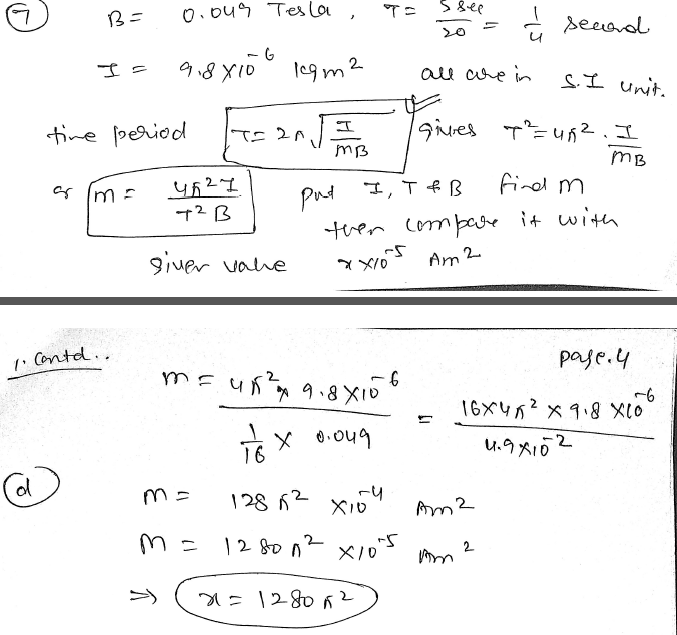
In a uniform magnetic field of 0.049 T, a magnetic needle performs 20 complete oscillations in 5 seconds(AXIS OF ROTATION IS VERTICAL WHILE FIELD IS HORIZONTAL). The moment of inertia of the needle is 9.8 × 10^–6 kg m^2. If the magnitude of magnetic momen
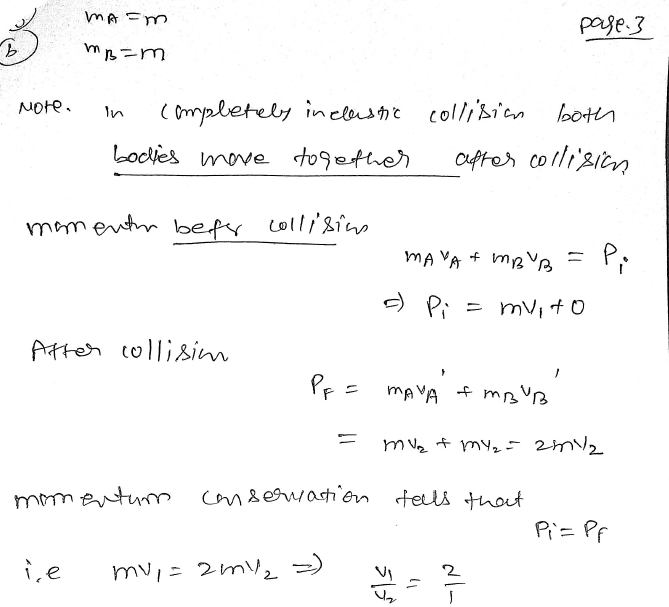
Two bodies A and B of same mass undergo completely inelastic one dimensional collision. The body A moves with velocity v1 while body B is at rest before collision. The velocity of the system after collision is v2. The ratio v1 : v2 is ?
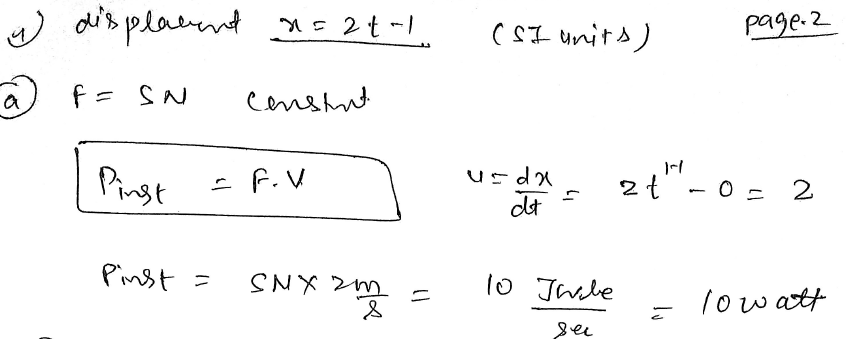
At any instant of time t, the displacement of any particle is given by 2t -1 (SI unit) under the influence of a force of 5N. The value of instantaneous power is (in SI unit)? NEET UG2024
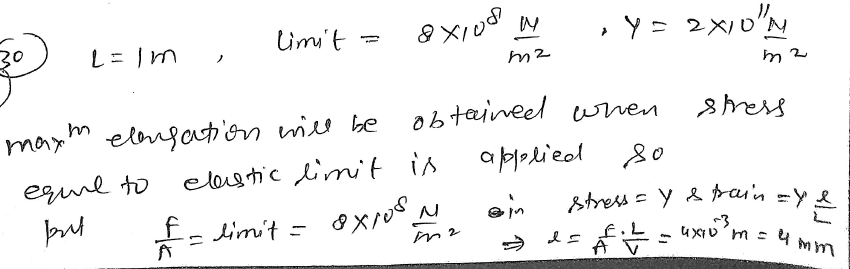
The maximum elongation of a steel wire of 1 m length if the elastic limit of steel and its Young’s modulus, respectively, are 8 × 10^8 N m–2 and 2 × 10^11 N m–2, is? NEET UG2024
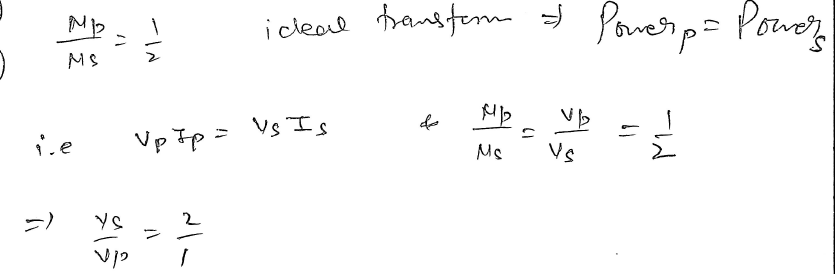
In an ideal transformer, the turns ratio is Np : Ns = 1:2, The ratio Vs :Vp is equal to (the symbols carry their usual meaning)? NEET UG2024
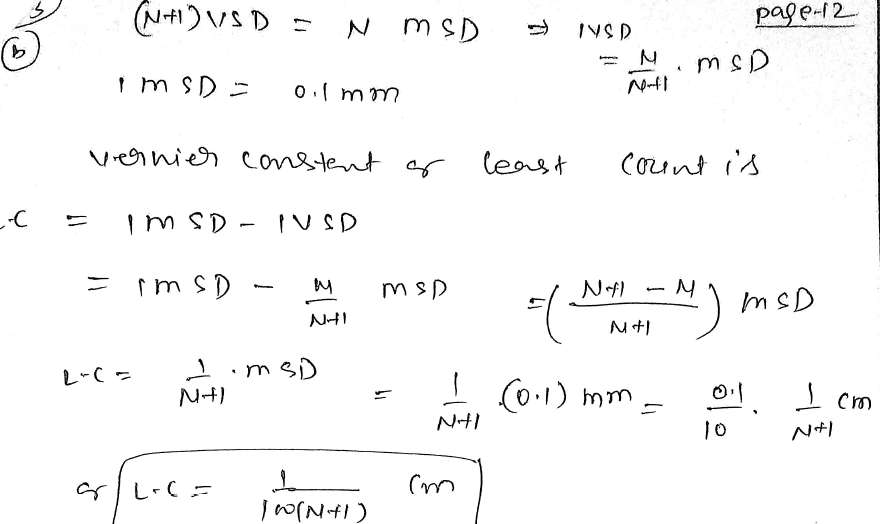
In a vernier calipers, (N + 1) divisions of vernier scale coincide with N divisions of main scale. If 1 MSD represents 0.1 mm, the vernier constant (in cm) is?(NEET UG2024)
Decision making and integrity
When maintaining and promoting PEACE alongside upholding INTEGRITY is kept at center of decision making then chances of regret are minimum.
-Lovekush Kumar
Does Solid angle have both, unit and dimension formula?
"No" it is has only unit (steradian) not DF
Approach=
Step 1. formula- solid angle is the ratio of area of segment to the square of radius of the sphere of which the segment is a part
Step 2. DF of each paramter in the formula, as area and square of radius both are a type of length square or in other words "both" have dimension of length square so their ratio becomes dimensionless.
Some key words helpful while solving problems of kinematics
Following notations / inferences (right side) may be written / considered when you read the lines below (left side)
Uniform linear motion a=0
started from rest u=0
comes to rest v=0
stopped v=0
pentrated through distance x and stopped v=0
straight line and unidirectional speed=velocity (magnitude)
vertically upward motion u and g opposite sign
vertically downward motion u and g same sign
higher slope of x-t graph higher velocity
displacement in 5th second dispacement in 5 second - displacement in 4 second
constant velocity graph between v & t will be a line paralled to time axis.
Area under v-t graph Displacement as x=vt
Best Wishes
Some tips for approaching a NEW physics numerical
Following step by step method may be followed for solving NEW physics numericals:
Step 1- P- M i.e. Physics to maths, write given values with thier NOTATION
e.g. if acceleration is given as 5 meter per second sqaure then wrtite a=5 ms-2 , time 2 sec as t=2s
Step-2 H-M i.e hidden to maths, write hints and indirect statement by identifying correct notation
e.g. if it is given that body was initialy at rest or started from rest then write u=0
Please note- Convert all given values in MKS system (or any other single system of units) before calculation
Step-3 TF/DF/CF, topic formula/desired formula/chapter formula
now decide which formula is to be utilised for desired quantity like if final velocity v is asked then look for formula "having" v,u,a and t (given and asked)
if you are unable to pick suitable formula then write chapter formula(main formula of a chapter) then look how can you find the quantities involved in the formula, for example if change in momentum is asked then find mass(m) using given data (mass may be given by the hint that force of 10 N produces accelration of 2 m per second sqaure then it will simply mean that mass is 5 kg)
In above case two formulas are utilised so correlation is done in step-4
Step-5 put values and solve neatly.
Please note- Initially some students may find it boring and lenthy but with passage of time and practice it will become your habit to approach all questions by this method and then it will take quite less time to analyze and solve problems even without writing many of the steps. Once it becomes your habit, it will become quite easier to approach new questions which you have not solved earlier.